JA Malta recognition highlights the vital role of financial journalism in strengthening financial literacy, informed decision-making and public accountability
Malta, 15 October 2026 – The Financial Journalism Excellence Programme (FJEP), an initiative developed by Market Accents, has won the Sustainable Financial Literacy Award at the Financial Capability Awards 2026, organised by JA Malta Foundation.
The award was presented by the Financial Intelligence Analysis Unit (FIAU) at a ceremony held on 15 October at the Corinthia Hotel, San Gorg. The awards recognise initiatives contributing to financial education, inclusion and financial capability in Malta.
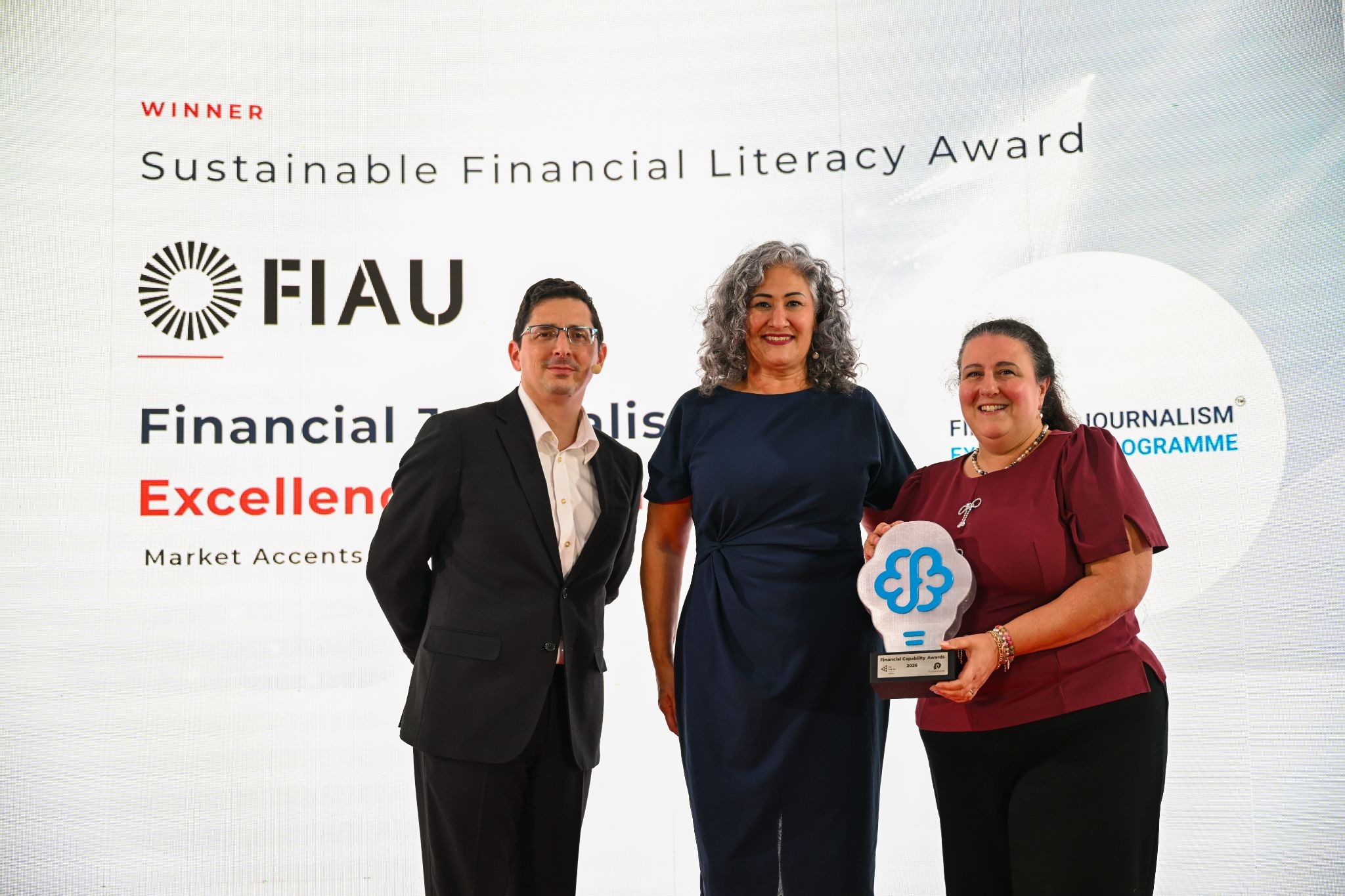
Market Accents receiving the FIAU Sustainable Financial Literacy Award at the Malta Financial Capability Awards 2026. From left, Matthew Caruana, CEO at JA Malta, Noreen Burroughes Cesareo MBE, Principal at Market Accents and Catherine Zammit, Communications & PR Manager at Financial Intelligence Analysis Unit (FIAU)
The award highlights an important but often overlooked part of the financial literacy ecosystem: the role of financial journalism and communicators in helping the public understand money, financial information, recognise risks, question claims and make informed decisions that affect their financial wellbeing.
Created and directed by Noreen Burroughes Cesareo MBE, Principal of Market Accents, with international financial journalist Tom Burroughes as lead journalist, the inaugural Financial Journalism Excellence Programme took place at the University of Malta on 27–28 August 2026. It was developed specifically for Malta and brought together journalists and media professionals with representatives from financial services, regulation, financial intelligence, academia and business.
While many financial literacy initiatives focus on educating consumers directly, FJEP invests in those who shape public understanding through news, digital media and public debate. invests in those who shape public understanding through news, digital media and public debate. Its relevance is underscored by the OECD/INFE 2023 International Survey of Adult Financial Literacy, which found that only 46% of adults surveyed in Malta met the minimum financial knowledge target, compared with 58% across participating OECD countries.
FJEP was built around the principle “Newsroom – Not Classroom”. The two-day programme combined practical masterclasses, expert discussions, investigative techniques, consumer finance reporting, digital journalism, AI and collaborative editorial exercises. Participants worked with real-world financial information, explored how to challenge corporate and regulatory announcements, and examined the importance of evidence, context, verification and the right of reply. The programme culminated in an Expert Newsroom Clinic, focused on planning coverage of Malta’s forthcoming Budget. A purpose-built Financial Journalism Toolkit provided practical frameworks and resources for continued professional use, while successful completion carried 10 CPD hours.
Commenting on the award, Noreen Burroughes Cesareo MBE, Programme Director, said:
“Financial literacy is not only about what people are taught directly. It is also shaped by the information they encounter every day, the questions asked on their behalf and how financial decisions and developments are explained to them.
“We created the Financial Journalism Excellence Programme because journalists and communicators play an important role in making complex financial information understandable, but also in scrutinising claims, challenging assumptions and holding institutions and decision-makers to account.
“Receiving this award is particularly meaningful because it recognises the importance of investing in those who communicate financial information as part of the wider effort to strengthen financial literacy. Our ambition from the outset was to create something that would extend beyond two days of training and contribute to stronger financial journalism and public understanding in Malta.”
Tom Burroughes, Group Editor of the WealthBriefing group of newswires, based in London, and Lead Journalist for the programme, added:
“Good financial journalism requires more than reporting figures or repeating what institutions say. Journalists need to know where to look, which questions to ask, how to test the evidence and when to challenge the information put before them.
“The programme gave participants the opportunity to apply these skills to real financial stories and engage directly with people working across the financial sector. Whether reporting on savings, pensions, investments or public finances, well-researched journalism helps people understand the issues and make better-informed choices. Strengthening financial journalism is therefore also an investment in financial literacy.”
The inaugural programme brought together 25 participants, including 10 media representatives, in a deliberately focused setting that encouraged open discussion and professional exchange. It was very well received, with positive participant feedback highlighting the practical approach, relevance of the topics and opportunities to engage directly with journalists and professionals from across the financial sector.
The initiative benefited from collaboration and support from organisations across financial services, regulation, academia, professional development and the media, including the University of Malta, Malta Financial Services Authority (MFSA), Financial Intelligence Analysis Unit (FIAU), Bank of Valletta, APS Bank, Malta Association of Risk Management (MARM), VisitMalta, WealthBriefing and Corporate ID Group.
Professional connections established during the programme have continued through a dedicated participant network, supporting its objective of encouraging dialogue and knowledge-sharing beyond the event itself. The award provides further encouragement to build on the inaugural initiative and develop opportunities that strengthen financial journalism and its contribution to financial literacy, transparency and informed public debate in Malta.
ENDS
Notes to editors
About the Financial Journalism Excellence Programme
The Financial Journalism Excellence Programme is a Malta-focused professional development initiative developed by London-based advisory Market Accents to strengthen financial journalism and its contribution to financial literacy. Its practical “Newsroom – Not Classroom” approach brings together journalism, financial services, regulation and academia to develop investigative, analytical and editorial capabilities. The inaugural programme was held at the University of Malta on 27–28 August 2026 and offered 10 CPD hours for successful completion.
About the Financial Capability Awards
Organised by JA Malta Foundation, the annual Financial Capability Awards recognise contributions to financial literacy, education and inclusion, including initiatives addressing sustainable financial literacy, entrepreneurship education and the gender gap.
Further information: https://jamalta.org/fincap-awards/
About Market Accents
Market Accents is a strategy, market development and communications consultancy founded by Noreen Burroughes Cesareo MBE. Its work includes communications and business strategy, international market development, stakeholder engagement and professional capacity-building.
Media enquiries
Market Accents
Noreen Burroughes Cesareo MBE
Programme Director, Financial Journalism Excellence Programme
Principal, Market Accents